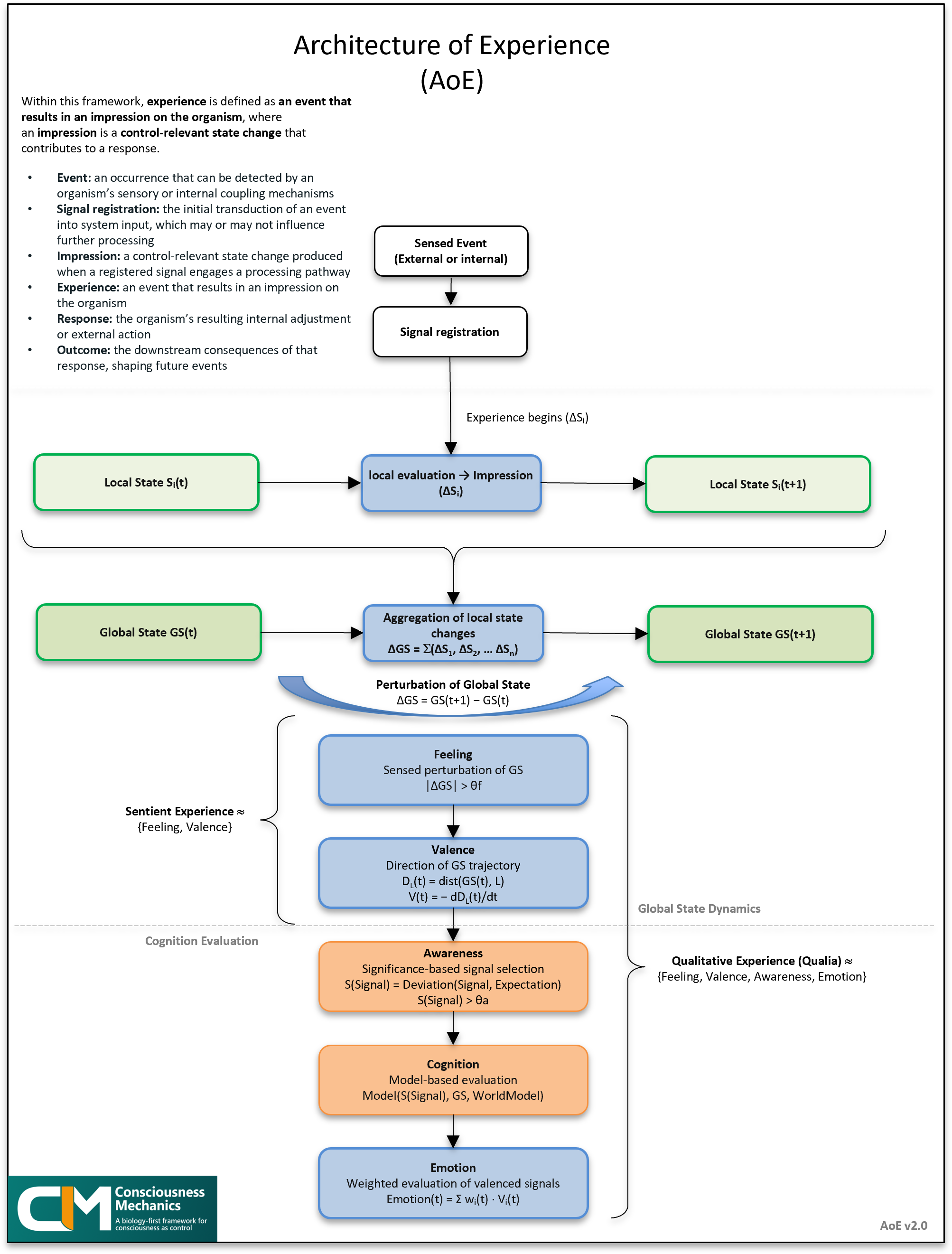
The Architecture of Experience (AoE) is the primary experience branch
within Consciousness Mechanics (CM). It explains how experienced events are
processed, integrated, and expressed within an organism, from local state change
through to feeling, valence, awareness,
cognition, and emotion.
Within this framework, experience is defined as
an event that results in an impression on the organism,
where an impression is a control-relevant state change
that contributes to a response.
Not every event becomes an experience, and not every experience becomes felt, attended,
or cognitively evaluated. AoE explains how local impressions contribute to wider organism-level
state change, and how significant perturbations in global state can give rise to
feeling, valence, awareness, cognition, and emotion.
Experience: definition and threshold
AoE begins from a simple clarification: experience is not raw sensing.
An organism may be exposed to an event, and a sensory surface may register it, without that event
becoming an experience in the mechanistic sense used here.
Working definitions
Event: an external or internal occurrence that can be detected by an organism’s sensory or internal coupling mechanisms
Signal registration: the initial transduction of an event into system input, which may or may not influence further processing
Impression: a control-relevant state change produced when a registered signal engages a processing pathway
Experience: an event that results in an impression on the organism
Response: the organism’s resulting internal adjustment or external action
Outcome: the downstream consequences of that response, shaping future events
What this clarifies
Not every event becomes an experience
Not every registered signal crosses threshold or engages a control pathway
A sensory fluctuation or sub-threshold trigger may be detected without leaving an impression
An event becomes an experience only when it produces a control-relevant state change that contributes to a response
Not every experience becomes felt, attended, or cognitively evaluated
This distinction is important because AoE is concerned with how experiences are processed,
not with treating every environmental occurrence as already equivalent to feeling, awareness, or cognition.
An event may leave only a minimal local impression, or it may propagate much further through the architecture.
How this branch is organised
Core map
AoE provides the umbrella explanatory map for the structure of experience within CM
Global State sits at the centre of the account, with perturbation shaping experiential organisation
Feeling, Valence, Awareness, Cognition, and Emotion are treated as distinguishable layers rather than one undifferentiated block
Navigation logic
This page functions as the umbrella header for the AoE branch
More focused pages on Global State and the experiential layers can sit beneath it over time
The aim is to guide navigation without collapsing experiential organisation into the broader control architecture
AoE at a glance
This visual summarises the current public interpretation of AoE, showing how a
sensed event is registered, how local evaluation produces an
impression (ΔSᵢ), and how the aggregation of local state changes contributes to
global state perturbation (ΔGS).
In this framework, experience begins locally, when an event results in an
impression on the organism. AoE does not treat experience as identical to
feeling, awareness, or cognition. Instead, it shows how local state change can contribute to
wider organism-level state change.
The diagram should therefore be read as a processing map of experienced events.
Feeling marks the sensed perturbation of global state, with
further experiential organisation, including valence, awareness,
cognition, and emotion, depending on how that perturbation is
subsequently evaluated.
The following concepts make up the AoE branch. Each marks a distinct part of the
experiential structure described by AoE and will serve as an entry point for more
focused pages as the branch expands.
MODEL
Global State (GS)
The organism-level state variable at the centre of the AoE account.
Perturbations in global state provide the basis for layered experiential structure.
Coming soon
MODEL
Feeling
The basic experiential occurrence of organism-level state perturbation.
In AoE, feeling marks the sensed occurrence of a change that matters to the organism.
Coming soon
MODEL
Valence
The viability-relevant direction or significance of state change.
Together, feeling and valence capture the most basic felt and directed structure of experience.
Coming soon
MODEL
Awareness
The selective registration of viability-relevant signals for wider processing.
AoE keeps awareness distinct from both raw feeling and full cognition.
Coming soon
MODEL
Cognition
The layer in which experience is integrated into modelling, interpretation,
comparison, and evaluation. AoE treats cognition as operating on already structured experience,
not as the source of all experience.
Coming soon
MODEL
Emotion
The higher-order experiential organisation arising from the interaction of lower layers.
In AoE, emotion is treated as a structured outcome rather than a primitive indivisible category.
Coming soon
MODEL
Sentience and qualitative experience
A clarification of how AoE uses these terms.
Sentient experience is approximated as { Feeling, Valence },
while broader qualitative experience is approximated as
{ Feeling, Valence, Awareness, Emotion }.
Coming soon
Experience, AoE, and the wider framework
Experience, AoE, and the CCM capability layers (CLn)
describe different parts of the same architecture and should not be collapsed into one another.
Experience
Experience occurs when an event leaves an impression on the organism
This begins locally, at the level of control-relevant state change (ΔSᵢ)
It does not require feeling, awareness, or cognition
What matters is that the event produces an impression that contributes to organism-level processing
AoE
AoE explains how experiences are processed, integrated, and expressed
It begins with local impression formation and local state change
Global state perturbation arises through aggregation of local state changes (ΔGS = ΣΔSᵢ)
Feeling, valence, awareness, cognition, and emotion describe progressively richer forms of experiential organisation
CLn
The CL hierarchy describes the organism’s structural control capacity
Lower CL levels can still host experiences if an event leaves an impression
Higher CL levels support richer propagation, integration, and modelling of those experiences
CLn helps determine how far experience can propagate within the system
Broader CM / CCM
CM defines the overall viability-regulating control architecture
AoE describes the experiential organisation within that architecture
CCM describes the cumulative capability structure available to support it
These are related layers of the same framework, not competing definitions
Put simply: experience answers whether an event leaves an impression,
AoE explains how that experience is handled, and CCM
describes the structural capacity available for that handling.