Consciousness Mechanics (CM)
Framework and Control Loop
This page introduces Consciousness Mechanics (CM) as a biology-first framework for defining consciousness in functional terms, not as a mysterious property to be described after the fact, but as a concrete organism-level control architecture.
The page begins with the core definition, then develops that definition through the CM control loop, showing how consciousness can be understood as a continuous process of detecting change, evaluating its significance for viability, selecting response, acting, and updating organism state.
From that foundation, CM sets up the wider framework: a clear control architecture that can later be extended into comparative capability structure through CCM, and into experiential structure through AoE.
The problem with consciousness
Consciousness research is not short of theories. What it lacks is a clear and consistent definition of what consciousness actually does within a system.
Most approaches attempt to explain consciousness by focusing on a particular layer of behaviour or implementation, then treating that layer as the whole problem.
- Neural correlates, mapping brain activity to reported experience
- Information-based theories, describing structural or causal complexity
- Predictive models, framing perception as inference and expectation
- Quantum or physical theories, proposing specific substrate-level mechanisms
- They describe aspects of system behaviour, not the full control architecture
- They often assume consciousness is something that must be “generated” or “added”
- They blur together experience, cognition, and action as if they are the same thing
- They lack a clear mapping from signal → evaluation → action at the organism level
The result is a fragmented landscape of partial explanations. Each captures something real, but none clearly specifies how a system uses information to regulate its own continued existence.
Without that grounding, the field is left asking what consciousness is, before establishing what role it plays. CM starts by resolving that gap.
The core definition
CM defines consciousness by what it does. On this view, consciousness is the organism-level mechanism through which living systems detect change, evaluate its significance, and generate action in ways that sustain ongoing viability.
It is not a late add-on, a human-only phenomenon, or something layered on top of biology once sufficient complexity appears. It is part of the control logic through which an organism maintains itself in the face of change.
This shift, from defining consciousness as a property to defining it as a function, allows the problem to be stated in concrete terms.
If consciousness is a viability-regulating control architecture, then its structure should be expressible. The CM control loop is that structure.
Within this wider framework, experience is understood as an event that leaves an impression on the organism, where an impression is a control-relevant state change that contributes to a response. This keeps experience tied to control, rather than treating it as something separate from the organism’s viability-regulating architecture.
The CM control loop
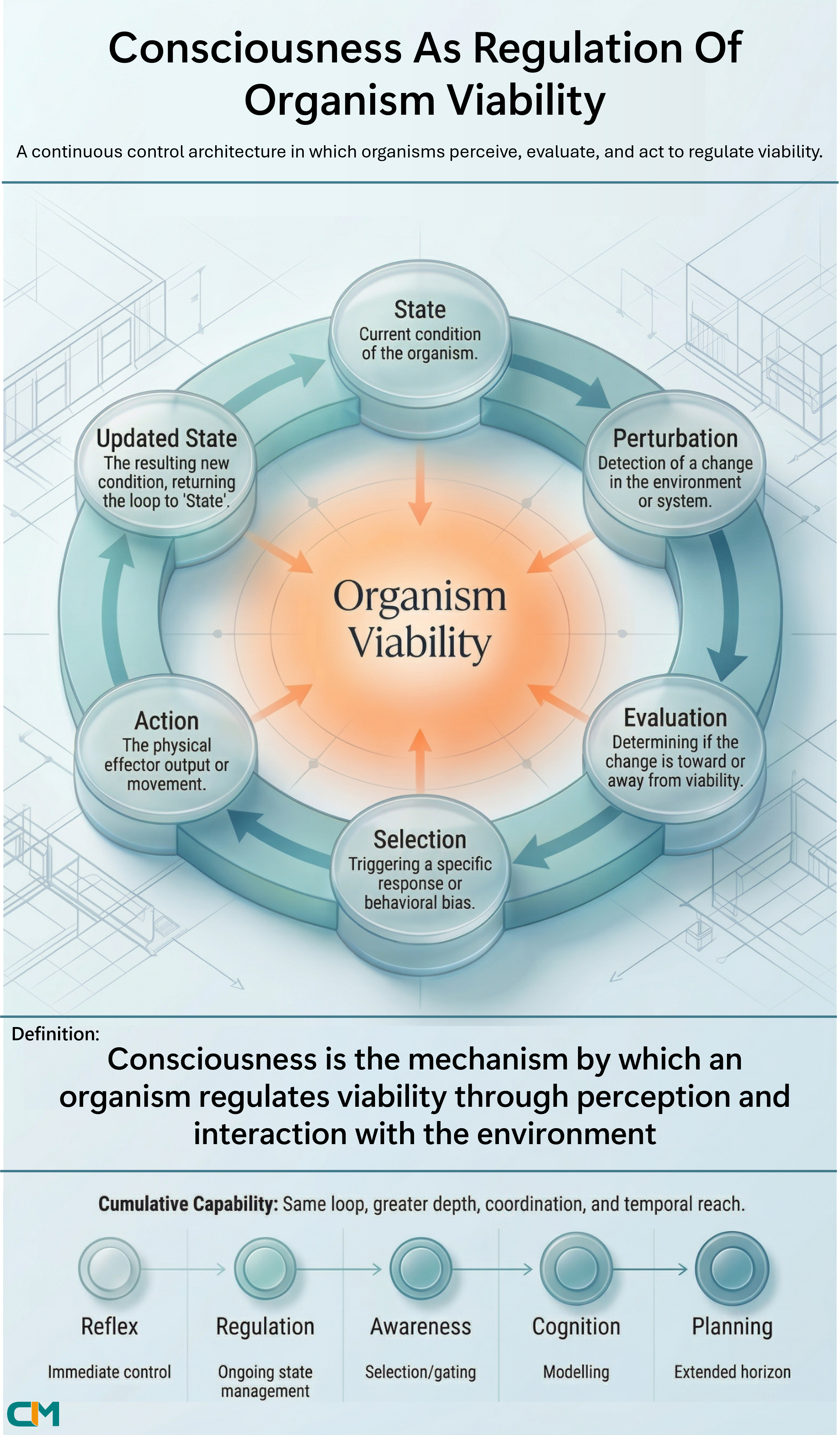
The figure below expresses the central CM claim in its simplest form. Consciousness is framed as a continuous regulatory loop organised around organism viability. It is not a sequence added on top of life after the fact. It is the ongoing architecture by which an organism remains coupled to its world and regulates its own condition over time.
In shorthand: State → Perturbation → Evaluation → Selection → Action → Updated state.
The lower strip in the graphic shows that increasing capability does not introduce a different mechanism. It extends the same loop through greater depth, coordination, and temporal reach.
A concrete example: the loop in action
The CM control loop appears directly in behaviour. A simple thermal reflex shows the full structure in action:
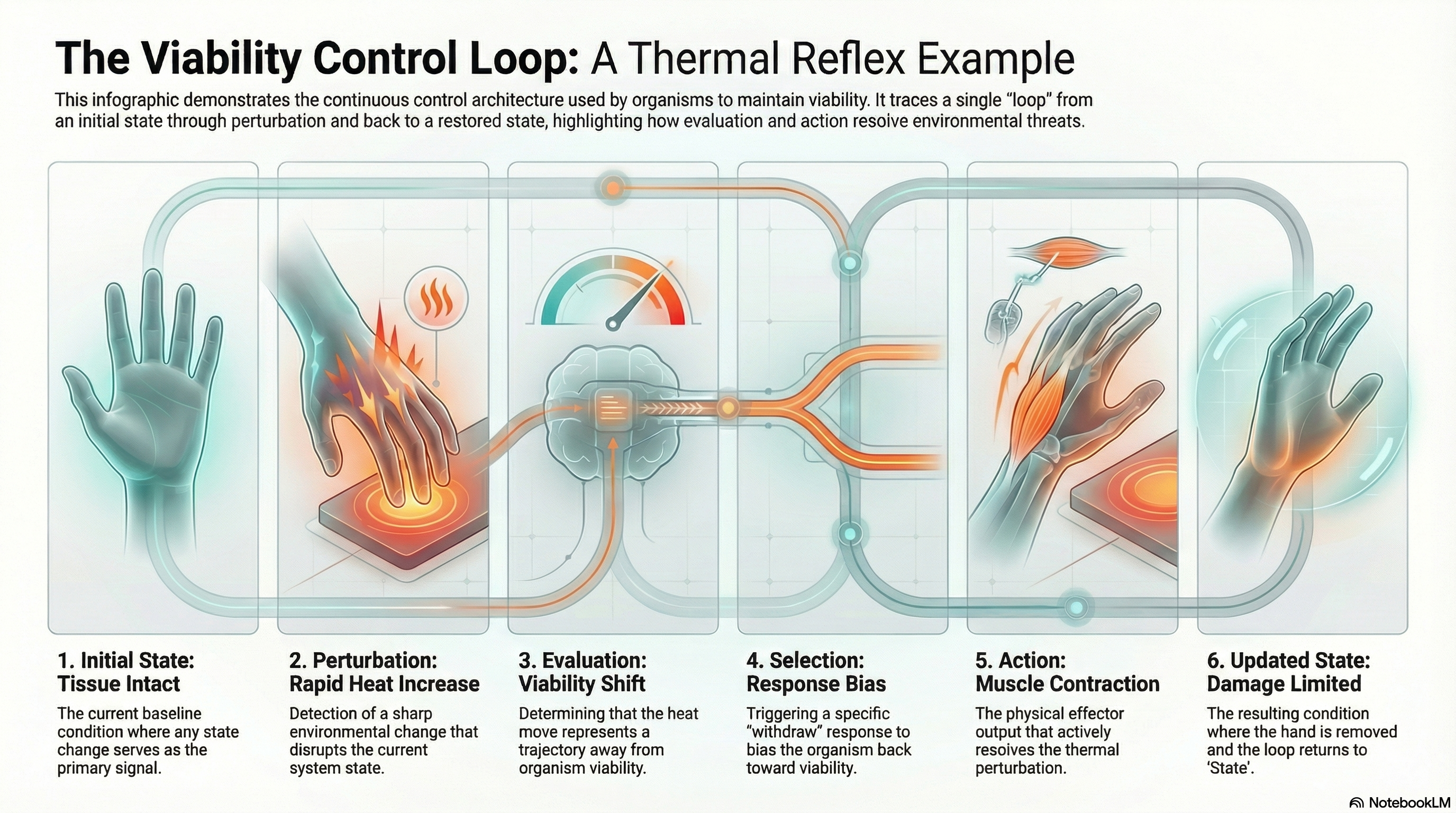
Nothing additional is required. There is no separate stage where “pain is experienced” and then a decision is made to act.
The state change is the signal. The evaluation biases response. The action resolves the perturbation.
What are often treated as “experience” and “action” are not separate stages, but different aspects of the same organism-level control process.
The same loop, greater depth
If consciousness is a viability-regulating control architecture, then an immediate question follows: why do simple and complex organisms appear so different?
The CM answer is that they do not operate under different frameworks. They operate within the same control architecture, extended with additional components that increase depth, coordination, and temporal reach.
What changes is not the underlying framework, but the capabilities available within it.
- Reflex, immediate control
- Regulation, ongoing state management
- Awareness, selection and gating of signals
- Cognition, model-based evaluation of possible states
- Planning, extended temporal organisation of behaviour
- Representational depth, what can be tracked
- Coordination complexity, what can be integrated
- Temporal horizon, how far ahead control can extend
At every level, the same control framework applies. What changes is the addition of new components that expand what can be represented, how signals are coordinated, and how far control can extend through time.
This is why CM does not treat complexity as the appearance of a new kind of consciousness, but as the progressive extension of a shared architecture through additional capability.
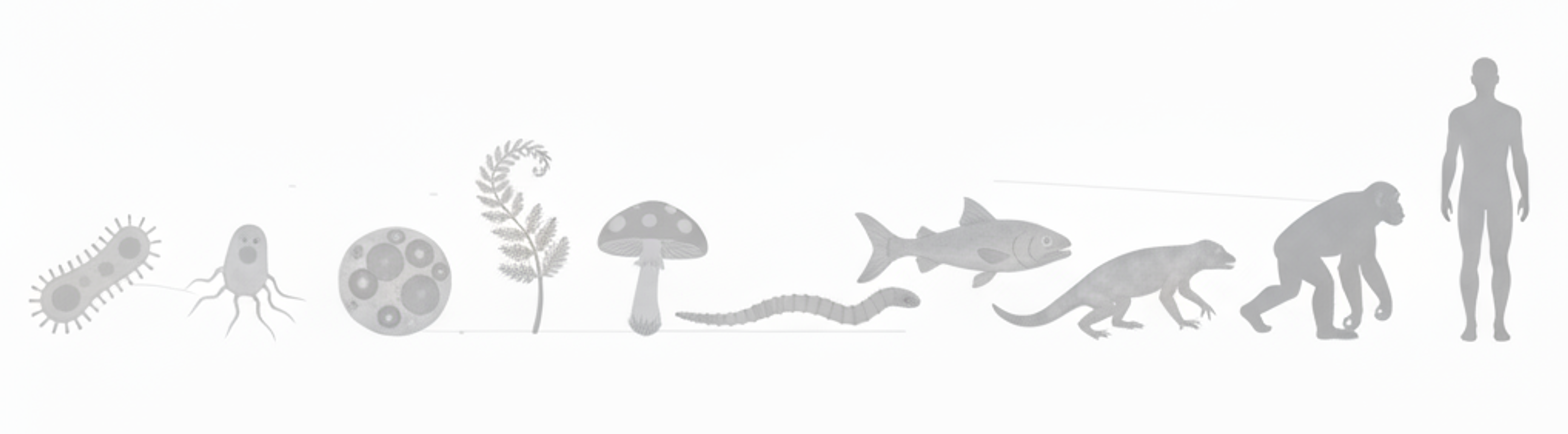
This expansion can be seen across life, not as different kinds of consciousness, but as increasing extension of the same control architecture.
What follows from the definition
- It is a biology-first framing of consciousness as regulation of organism viability
- It describes control architecture across life without assuming human-like cognition
- It is broader than awareness and broader than cognition
- It maintains a control–execution boundary without collapsing into substrate detail
- Consciousness is not treated as a late add-on that appears only after sufficient complexity
- It is not a mysterious ingredient layered on top of biology
- It is not equated with cognition, report, or reflective access
- It is not restricted to familiar human or animal cases
Once consciousness is defined as a viability-regulating control architecture, the problem becomes one of specification, not explanation.
The question is no longer how consciousness is generated, where it “enters” a system, or how it relates to cognition or experience. Those questions arise from treating consciousness as something separate from control.
Instead, the task is to determine how this architecture is structured, how it scales across systems, and how different capabilities arise within it.
This leads directly to two requirements: a way to compare how the architecture is extended across life, and a way to describe how experience is structured within it.
From CM to CCM and AoE
CM is the root framing. It defines the broad architectural target, consciousness understood as organism-level control organised around the regulation of organism viability.
CCM formalises how the same control architecture scales across life. It makes cumulative capability commitments explicit and uses the H scale for temporal horizon and the K scale for structural capacity.
These are not separate systems. They are ways of specifying how far the same architecture has been extended.
AoE explains how experience is structured within the wider control architecture. Within this framework, experience is defined as an event that leaves an impression on the organism, where an impression is a control-relevant state change that contributes to a response.
AoE then explains how such experienced events may remain local or propagate into richer forms of organisation such as feeling, valence, awareness, cognition, and emotion.