The Consciousness Component Model (CCM) is the primary
comparative architecture branch within Consciousness Mechanics (CM).
It organises consciousness capability as a cumulative hierarchy of bounded control components,
written as CL1 … CLn.
Where CM defines the broad architectural target, organism-level control organised around the
regulation of organism viability, CCM specifies how that architecture is extended through
additional component commitments, how those commitments are bounded, and how capability ceilings
can be compared across life.
This page functions as the branch header for CCM. It introduces the core map,
shows how the branch is organised, and provides entry points for the component hierarchy,
methodological approach, classification axes, and future reference material as they are published.
How this branch is organised
Core map
CCM provides the umbrella comparative map for bounded control architecture within CM
CL1 … CLn express the cumulative component hierarchy, with higher ceilings extending rather than replacing lower ones
Capability claims are treated as explicit architectural commitments rather than loose descriptions of complexity, intelligence, or awareness
Navigation logic
This page functions as the umbrella header for the CCM branch
More focused pages on the component hierarchy, notation, worked classifications, and reference material can sit beneath it over time
The aim is to guide navigation without collapsing comparative architecture into the separate experiential organisation handled by AoE
CCM at a glance
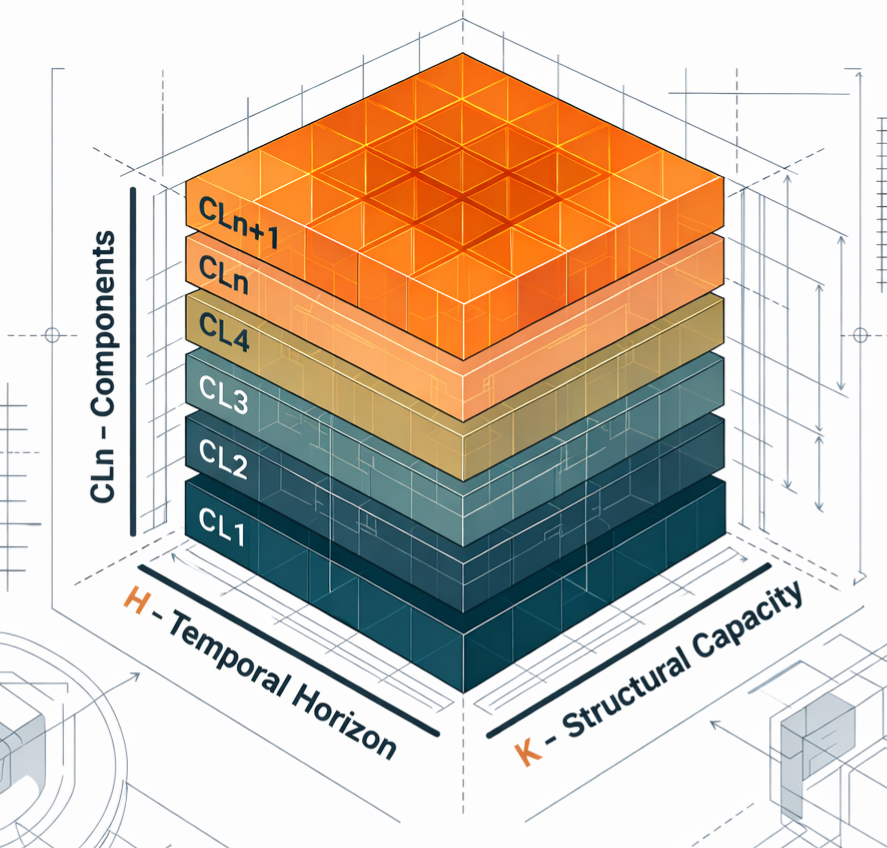
This visual summarises the current public interpretation of CCM, bringing together the
component hierarchy (CLn), temporal horizon (H), and
structural capacity (K) into a single comparative view.
The diagram should be read as a comparative architecture map, not as an
intelligence ladder or a scalar score. At the centre of the account is a simple idea:
different behavioural ceilings imply different bounded control commitments, and those
commitments can be made explicit and compared.
CLn hierarchy
The vertical stack represents cumulative component levels,
CL1, CL2, CL3, CL4 … CLn. Each added layer marks a new architectural
commitment required to explain a higher control ceiling.
Read page
H — Temporal Horizon
H expresses how far ahead control must extend. It captures future-relevant regulatory
depth, not human-style planning by default.
Read page
K — Structural Capacity
K expresses how much persistent internal structure control requires. It is about
required architecture, not neuron counts or vague complexity.
Read page
CCM branch map
The following concepts and reference areas make up the CCM branch. Published pages are linked
directly, while additional material is signposted here as the branch expands.
MODEL
Component hierarchy (CL1 … CLn)
The cumulative hierarchy of bounded control components that forms the backbone of
CCM. Higher levels extend lower ones through additional required commitments.
Read page
MODEL
Temporal Horizon Scale (H)
The scale used to classify future-relevant control depth within CCM.
Read page
MODEL
Structural Capacity Scale (K)
The scale used to classify persistent internal structural commitments within CCM.
Read page
MODEL
Approach
The methodological discipline behind CM and CCM. It explains how the framework is
built from biology-first grounding, explicit mechanism, conservative scope, and
hard architectural boundaries.
Read page
MODEL
Capability ceilings and notation
A guide to how ceilings are written and interpreted, including CLn notation and the
role of H and K in specifying bounded comparative claims.
Coming soon
MODEL
Discriminators and evidence anchors
The behavioural and architectural anchors used to justify when new component
commitments are required, and when lower ceilings remain sufficient.
Coming soon
MODEL
Worked classifications and examples
Example applications showing how CCM can be used to classify observed behavioural
ceilings without collapsing them into vague claims about intelligence or complexity.
Coming soon
DOC
SCCA reference
The more technical reference layer for CCM, covering component definitions,
execution boundaries, and formal specification detail.
Coming soon
How CCM relates to the wider framework
CCM explains the comparative architecture of conscious capability within the
wider CM framework. It does not by itself explain the full structure of experience, nor does it
replace the broader organism-level framing provided by CM.
What CCM is about
Cumulative control components and bounded ceilings
Comparative classification across life
Capability commitments made explicit and testable
The relation of component hierarchy to H and K constraints
What belongs elsewhere
CM defines the broad organism-level framing and core claim
AoE explains the layered structure of experience
H and K each have their own dedicated scale pages
Site-wide signals and updates sit outside the branch itself
This distinction matters. CCM is one part of the larger framework: it explains how capability
ceilings are structured and compared, while CM defines the broad architectural target and AoE
explains how experience itself is organised.