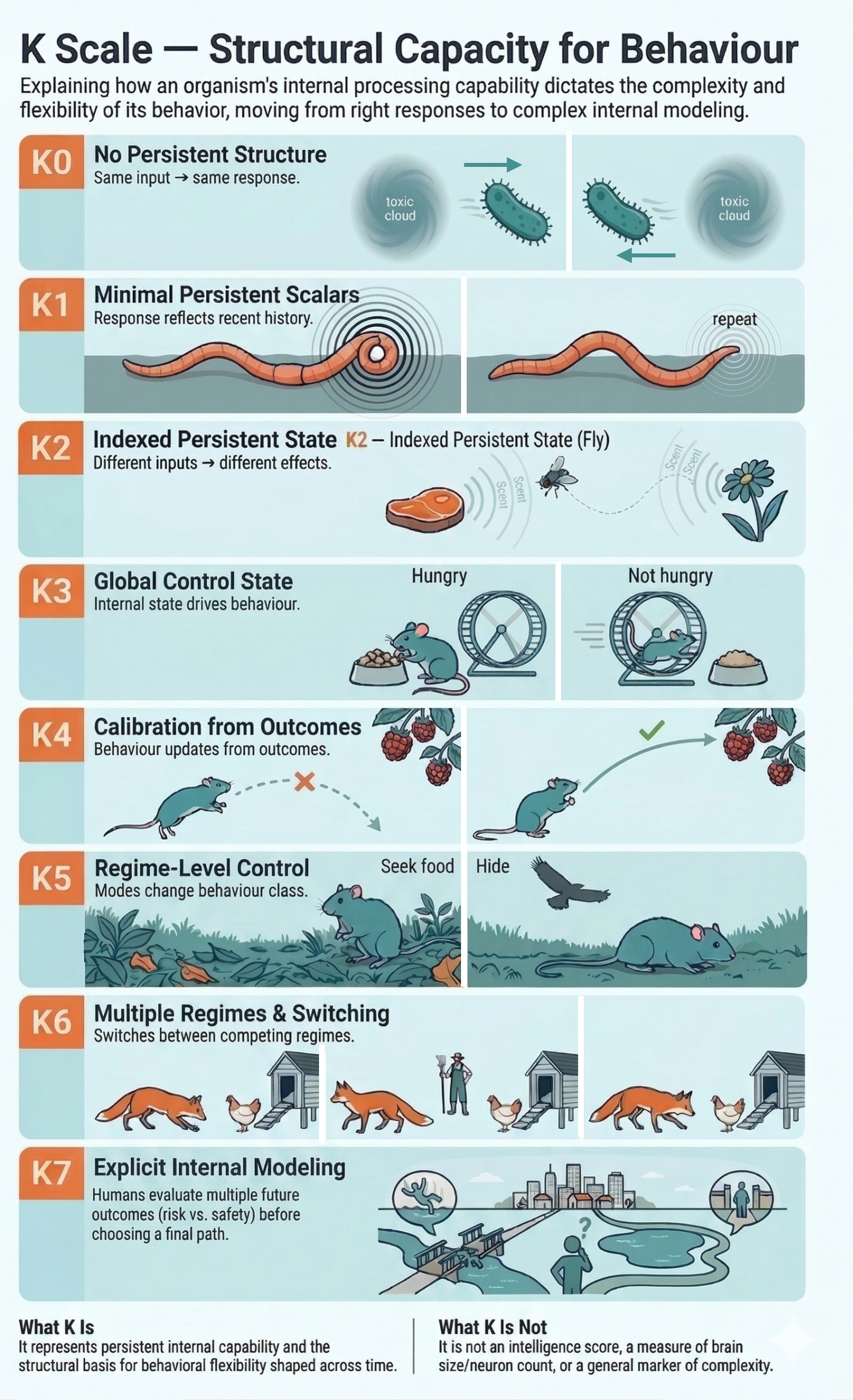
K expresses the structural capacity required for behaviour.
It is the axis used within CCM to classify what must persist internally
for a given behavioural class to be possible.
Rather than measuring intelligence or complexity, K specifies the
internal processing and persistence commitments required for behaviour,
from rigid same-input responses through to learning, regime switching,
and explicit internal modelling. In practical terms: what must exist internally for this behaviour to be possible at all?
K levels are read as bounded architectural commitments,
describing what must exist internally for the behaviour to occur,
not how impressive an organism appears.
How to read K
Capability axis, not intelligence ladder
K is a capability axis, not an intelligence ladder.
A higher K level means that more demanding internal structure must be present
for the behaviour under consideration.
Behaviour-first interpretation
Read K by asking what new behavioural flexibility appears at each step:
from identical responses, to sensitivity shifts, to differentiated responses,
then internal-state control, outcome-based learning, regime switching,
and finally explicit evaluation of future outcomes.
Why the distinctions matter
The K scale matters because distinct forms of behavioural organisation are often grouped together under
broad terms such as “intelligence”, “complexity”, or “learning”. But identical response, recent-history modulation, differentiated treatment of inputs,
internal-state control, outcome-based updating, regime change, switching, and explicit internal modelling are not the same thing.
By separating these levels, K helps make comparison more disciplined. It clarifies what class of internal capability is actually
being implied when we attribute a behaviour to an organism or system.
What it is
A conceptual structural-capacity axis for behaviour
An indication of the internal processing capability required for a behavioural class
A way of distinguishing different kinds of persistent internal organisation
What it is not
Not an intelligence score
Not a neuron-count proxy or brain-size ranking
Not a claim that rich world models exist at all levels
K scale infographic
This visual summarises the current public interpretation of the K scale, from
same input, same response through recent-history effects, differentiated
responses to different inputs, internal-state control, outcome-based updating, regime-level
shifts, switching between competing regimes, and finally explicit internal modelling.
The following definitions specify the K levels as bounded structural commitments,
indicating what must exist internally for each class of behaviour.
K0
No persistent structure
The same input produces the same response each time, with no retained variation or internal carry-forward affecting what happens next.
K1
Minimal persistent scalars
Response strength reflects recent history, so the same kind of disturbance can produce a weaker or stronger reaction on repetition.
K2
Indexed persistent state
Different kinds of inputs can carry different stored effects, allowing the organism to respond differently depending on what it encounters.
K3
Global control state
Internal state can override identical surroundings, so the same environment yields different behaviour depending on conditions such as hunger.
K4
Calibration from outcomes
Behaviour updates from success and failure, allowing future attempts to be altered by what happened on previous attempts.
K5
Regime-level control
Behaviour changes by mode or regime, such as shifting from food-seeking to hiding when threat context becomes dominant.
K6
Multiple regimes and switching
Competing drives can alternate over time, so behaviour switches between regimes as context changes and then changes back again.
K7
Explicit internal modelling
Behaviour is guided by imagined future outcomes, allowing evaluation of risky versus safe routes before a final action is chosen.
K and persistent internal state
K is about what must persist internally across time for behaviour to be shaped by more than the immediate present.
At lower levels this may amount to little or no retained variation. At higher levels it includes state that can bias behaviour,
differentiate between input classes, encode prior outcomes, support regime switching, or contribute to explicit internal modelling.
The important point is functional rather than anatomical: not merely that some substrate exists, but that it supports behaviourally
relevant carry-forward from one moment to the next.
K and explicit modelling
The K scale does not assume that organisms possess rich world models at low levels. Most of the scale is about
simpler forms of persistence and behavioural organisation: repeated-response effects, input-specific differences, internal-state
bias, learning from outcomes, and mode switching.
Only at the highest end of the illustrated public interpretation does K move into behaviour that is best explained by
explicit internal modelling of possible future outcomes.