Temporal Horizon Scale (H)
H expresses how far ahead behaviour can be regulated in behaviour-class tick units. It is the temporal horizon axis used within CCM to classify future-relevant control depth.
The H scale is not a measure of intelligence, complexity, or generic planning ability. It specifies the temporal reach of control, whether behaviour is governed only by the present, by near-future extrapolation, by persistent state carried across episodes, by future needs within the organism’s lifespan, or by representations of times beyond lived experience.
H levels are read as bounded architectural commitments. They describe how far behaviour can be organised across time, not how cognitively sophisticated an organism appears in human terms.
How to read H
H is a temporal axis within the wider framework. A higher H level does not automatically imply greater intelligence, greater complexity, richer awareness, or human-like planning. It only means that behaviour depends on a longer temporal horizon of control.
H levels are governed by K, the system’s structural capacity, and by component definitions. An H assignment must be justified by the internal control commitments required for the behaviour, not by loose interpretation of surface performance.
Why the distinctions matter
The H scale prevents different forms of temporal control from being collapsed into a single vague idea of “planning” or “intelligence”.
Immediate reaction, short-horizon extrapolation, anticipatory readiness across ticks, post-event carry-forward, preparation for future needs, and reasoning about times beyond one’s lifespan are not the same kind of temporal organisation.
Treating these as distinct horizons makes behavioural comparison more precise, and keeps temporal reach separate from other axes such as structural capacity (K) or component depth (CLn).
- A temporal classification axis for future-relevant control depth
- A way to express how far ahead behaviour can be regulated in behaviour-class ticks
- A bounded classificatory axis used alongside CCM components and K scale constraints
- Not a generic planning score
- Not a synonym for intelligence, complexity, or imagination
- Not a free-standing behavioural label detached from mechanism
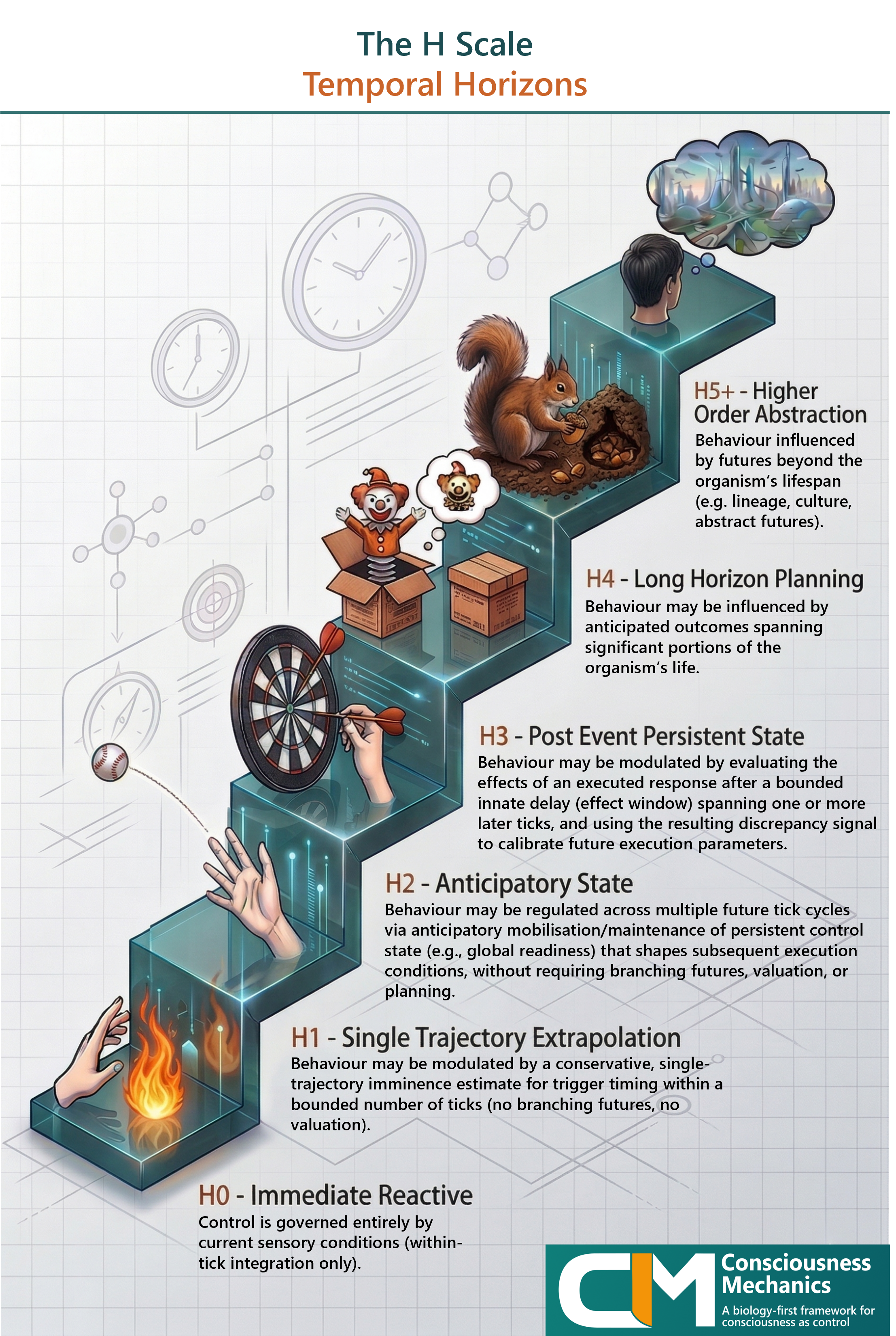
H scale infographic
This visual summarises the current public interpretation of the H scale, from immediate reaction through short trajectory extrapolation, anticipatory state, post-event persistent state, long-horizon planning, and beyond-lifespan abstraction.

H and tick
H is expressed in tick units. A tick is the organism’s minimum effective control update interval for the behavioural class under analysis, the shortest cadence at which control-relevant state can be sensed, integrated, and used to commit or dispatch response.
Tick boundaries are therefore defined by control-cycle completion, commit or dispatch, rather than fixed external time slices, and not by requiring that a physical motor programme has fully completed.
A single organism may exhibit multiple effective tick scales across different behavioural classes, for example fast defensive reflexes versus slower developmental, provisioning, or seasonal regulation.
In practical terms, H is always interpreted relative to the control cadence of the specific behavioural regime being analysed.